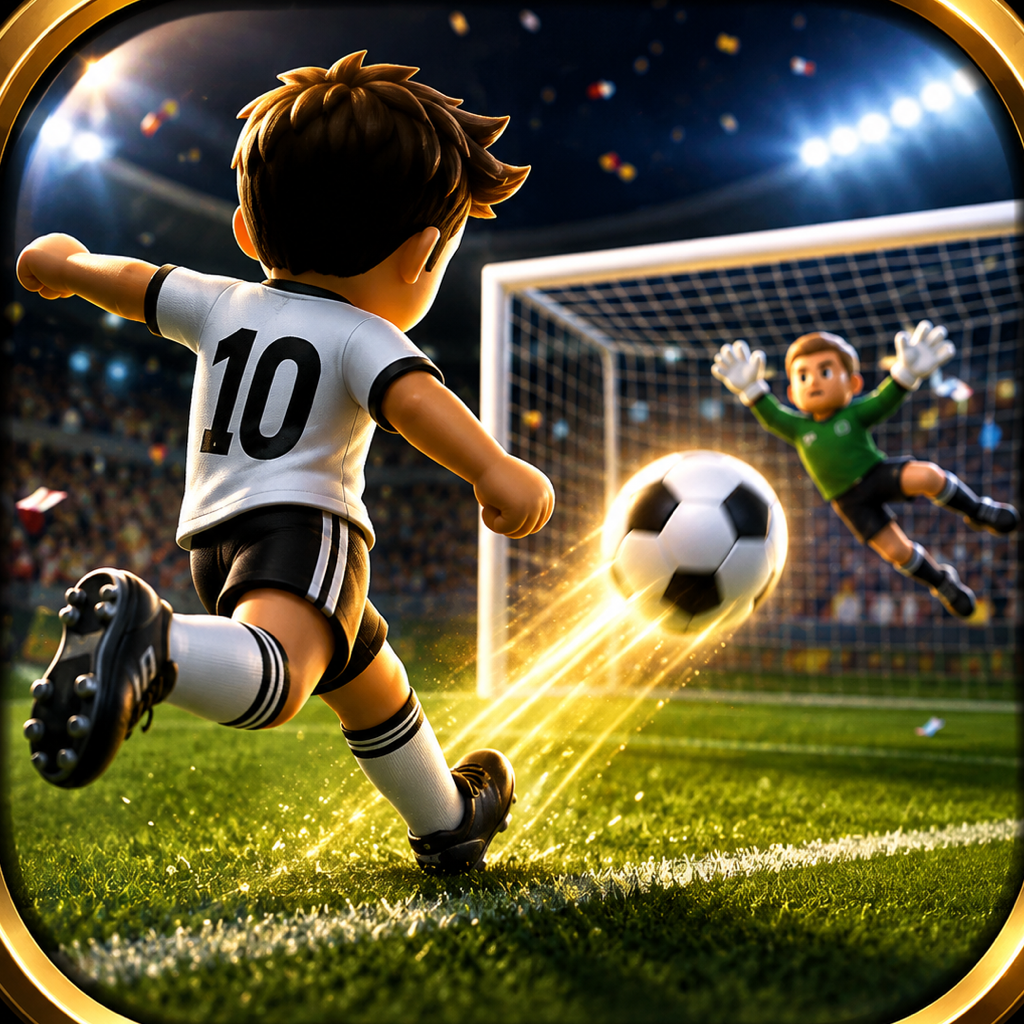
Penalty shootout rules, explained
A penalty shootout, officially called kicks from the penalty mark, decides a football match that needs a winner but is still level after full time or extra time. The two teams take turns shooting from the penalty mark, 11 metres from goal, against the other team's goalkeeper. This page covers the official rules and how Super Star, EU Studio's penalty game, turns them into a game.
The shootout at a glance
| Distance | 11 metres (12 yards) from the goal line |
| Goal | 7.32 m wide, 2.44 m high |
| Kicks | Five per team, taken alternately |
| If still level | Sudden death, one kick each at a time |
| Who may kick | Only players on the pitch when the match ended |
Before the first kick
The referee tosses a coin to choose the goal, unless the pitch or safety decides it. A second toss decides which team kicks first. If one team has more players on the pitch than the other, it reduces its number to match. All players except the kicker and the two goalkeepers wait in the centre circle. The kicking team's goalkeeper waits on the pitch, where the goal line meets the edge of the penalty area.
Taking the kicks
- 1.The teams kick alternately, one kick at a time.
- 2.Each team takes five kicks. If one team has scored more than the other could reach with all its remaining kicks, the shootout stops early.
- 3.If the score is level after five kicks each, the teams go on in pairs of kicks (sudden death) until one team scores and the other does not.
- 4.Each kick is taken by a different player. Every eligible player, the goalkeeper included, must kick before anyone takes a second one.
The goals scored in the shootout are not added to the match score. The match itself is recorded as a draw.
What counts as a goal
A kick is a goal when the whole ball crosses the goal line between the posts and under the crossbar. It still counts if the ball goes in off a post, the crossbar or the goalkeeper. The ball must be kicked forwards, and the kick is over as soon as the ball stops moving or leaves the field: there are no rebounds, and the kicker may not touch the ball a second time. The kicker may feint during the run-up, but not once the run-up is complete. If the kicker breaks a rule, the kick counts as missed and the kicker is shown a yellow card.
The goalkeeper's line rule
Until the ball is kicked, the goalkeeper must stay on the goal line between the posts, facing the kicker, without touching the posts, the crossbar or the net. Moving sideways along the line is allowed. At the moment of the kick, at least part of one foot must be touching the goal line or be level with it.
If the goalkeeper leaves the line too early and the ball goes in, the goal stands. If the goalkeeper saves it, the kick is taken again. If the ball misses or hits the woodwork, it is taken again only if the goalkeeper's offence clearly affected the kicker. In a shootout the goalkeeper is warned the first time and shown a yellow card for any further offence.
Playing in Super Star
Super Star is still in development, and this describes the game as it is now. It does not stage a two-team shootout. Each round is played at one end: either you take every penalty as the striker, or you stand in goal while the computer shoots. The mode decides how many shots you get and how many goals you need, and the round is played to the last shot unless it is sudden death.
Taking a shot
Swipe upwards from the ball towards the goal. One swipe sets everything:
| Your swipe | Your shot |
|---|---|
| Angle from straight up | Left or right; about 35 degrees reaches the post |
| Length | Height: short stays low, long lifts it, too long goes over the bar |
| Speed at the end of the swipe | Power, and so how much time the keeper gets |
| A bend in the swipe | Curve |
The POWER and CURVE meters show the shot while you aim. The keeper reads the straight line of your shot and commits to a dive at the kick. Curve moves the ball after that, so it beats a keeper who picked the right side but not the corner.
Every shot ends as a goal, or as saved, post, crossbar, wide or over. Unlike in real football, a shot that hits the post or the bar never goes in: it counts as a miss. Some rounds count only certain goals: top corners only, bottom corners only, or, in the crossbar challenge, only hits on the bar.
Keeping goal
Choose Goalkeeper and the computer takes five penalties at you. Keep out at least two to win the round; a shot that goes wide or over counts for you too. Swipe the moment the striker hits the ball: sideways picks the corner, upwards goes for the high ball. Dive early and you reach the post. Wait to see where it is going and your gloves arrive half extended. The striker's level follows yours, from Sunday League to World Class.
Keepers and modes
The computer keeper has six levels: Easy, Medium, Hard, Professional, Legend and World Class. A better keeper reads your shot more accurately, reacts sooner and reaches further.
- Career: 15 matches against named keepers, from five shots with three goals needed to eight shots with six needed.
- Tournament: three knockout cups (Weekend Cup, Golden Goal, World Championship) with a quarter-final, semi-final and final, and a coin entry fee.
- World Tour: five shots and three goals needed, at the stadium you pick; the keeper improves as your level rises.
- Daily Challenge: a new rule each day, the same for everyone, such as eight in a row, where one miss ends the round.
- Skill Challenge: small goal, top corners, crossbar challenge, and a perfect round of ten penalties where one miss ends it.
Goals earn coins and XP. Harder keepers pay more, corners pay more than the middle, and each goal in a row adds a bonus, up to ten in a row. Boots and shirts change how your striker looks, not how the ball flies.
Questions about the rules
- How many penalties does each team take in a shootout?
- Five each, taken alternately. If it is still level after that, the teams continue one kick each at a time until one scores and the other misses.
- Does a penalty count if it hits the post and goes in?
- Yes. It is a goal as long as the whole ball crosses the line between the posts and under the bar, whatever it touched on the way.
- Can the goalkeeper move before the kick?
- Sideways along the goal line, yes. The goalkeeper may not step forward off the line, and at the moment of the kick at least part of one foot must be on or level with the line.
- Can a player take two penalties in the same shootout?
- Only after every eligible player on the team, the goalkeeper included, has taken one. In a long sudden death, a second round of kickers then begins.
- Can the kicker score from a rebound in a shootout?
- No. The kick ends when the ball stops moving or leaves the field, and the kicker may not touch it a second time. Rebounds only exist for penalties during the match.